


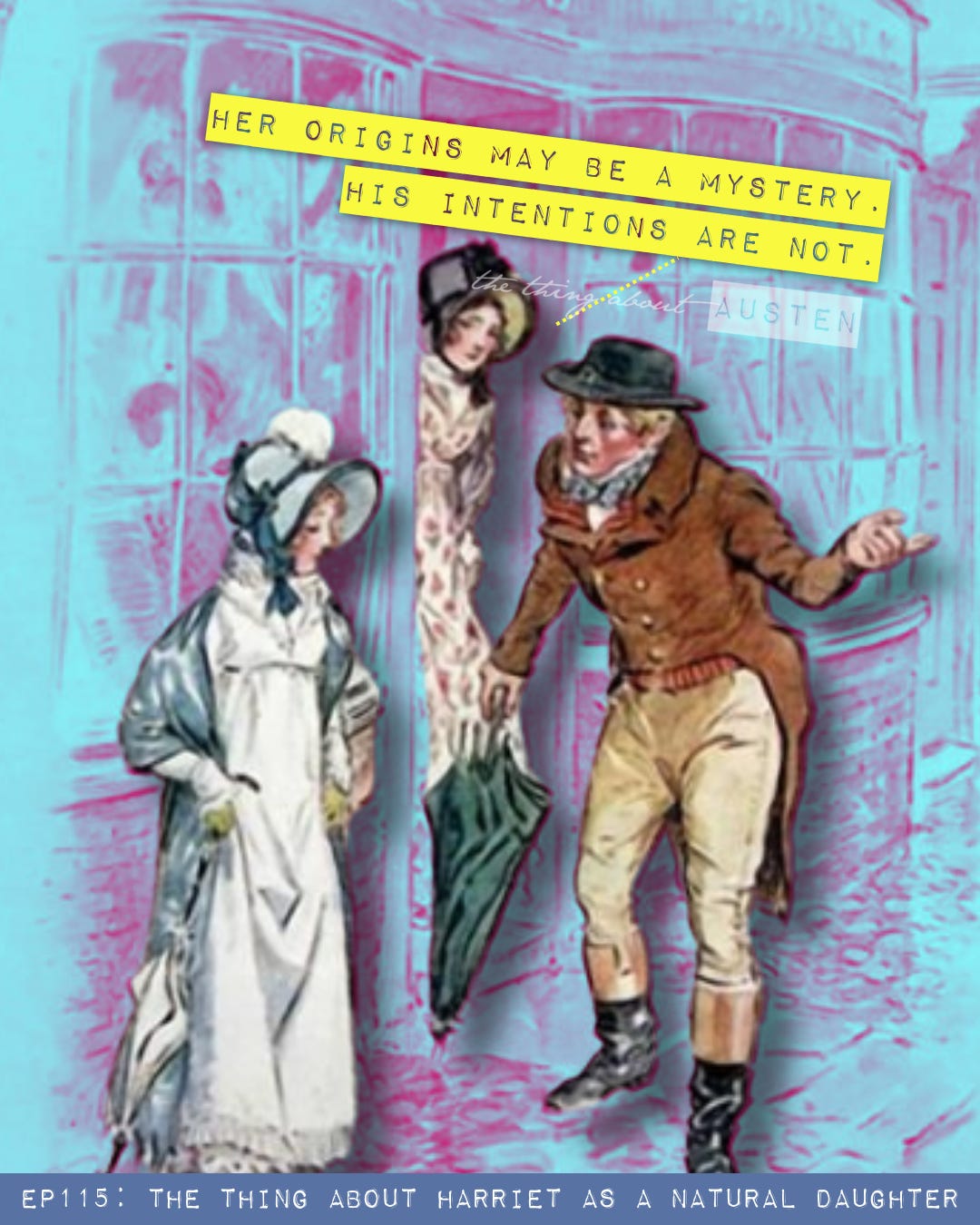
Emma has big plans for Harriet, and these plans require a backstory, which Emma is more than happy to concoct. This episode we unpack the meaning of the expression “natural daughter” and discuss the social context of illegitimacy in Austen’s time.
Selected Sources:
Bailey, Martha. “The Marriage Law of Jane Austen’s World.” Persuasions On-Line 36, no. 1 (2015).
Blackstone, William. An Analysis of the Laws of England. 1st ed. Clarendon Press, 1756.
Bradbury, Malcolm. “Jane Austen’s Emma.” Critical Quarterly 4, no. 4 (1962): 335–46. https://doi.org/10.1111/j.1467-8705.1962.tb01434.x.
Emery, Caroline. “Narrative Patterns of Illegitimacy and Infanticide in the Nineteenth-Century Novel.” Doctoral Thesis, Cardiff University, 2007. https://www.proquest.com/docview/1368988138?pq-origsite=gscholar&fromopenview=true&sourcetype=Dissertations%20&%20Theses.
Foreman, Amanda. Georgiana: Duchess of Devonshire. Random House, 1998.
Gibson, Kate. “Experiences of Illegitimacy in England, 1660-1834.” Doctoral Thesis, The University of Sheffield, 2018.
Gibson, Kate. Illegitimacy, Family, and Stigma in England, 1660-1834. Oxford University Press, 2022. https://doi.org/10.1093/oso/9780192867247.001.0001.
Lank, Edith. “‘The Word Was Blunder’: Who Was Harriet Smith’s Mother?” Persuasions 7, no. 1 (1985): 14–15.
Mortimer, Ian. The Time Traveler’s Guide to Regency Britain: A Handbook for Visitors to 1789-1830. Pegasus Books, 2023.
Selwyn, David. Jane Austen and Children. Bloomsbury Publishing, 2010.
Zunshine, Lisa. “Harriet Smith in Brunswick Square: ‘Common Sense’ Bastardy in Jane Austen’s Emma.” In Bastards and Foundlings: Illegitimacy in Eighteenth-Century England. Ohio State University Press, 2005.
For anyone who hasn’t listened to the episode yet, we’ll let you guess which Austen character we link to this iconic Mean Girls line.
Another thing about illegitimate girls--since the mother was an unwed mother, there was a fear, or perhaps a generally held belief, that the daughter might have inherited the morally lax propensities of the mother. Eliza junior was an obvious target for Willoughby since he might assume she doesn't have someone who will stand up and protect her the way a father or brother would protect a legitimate daughter or sister, but also, she was the more easily seduced because her mother fell from virtue. Brandon laments his failure in keeping her safe. Mr. Knightley urges Emma that Harriet will be "safe" and "respectable" if she marries young and goes to live with the Martin family on their farm. Not only is she a tempting target for seduction, she might be inclined to do as her mother did. Just reporting these attitudes, not endorsing them.
Colonel Brandon has to take care economically miss Williams and her child for life. So , Marianne through her marriage to colonel Brandon has to support Willoughbys (Natural) child for life! Just an observation i made by reading one of my favourite Jane Austen books.