


Mr. Bingley has brought a friend to the Meryton assembly, and everyone is abuzz with excitement. This episode we take a look at Mr. Darcy's bank balance and get into exactly what Austen is signaling with Darcy's ten thousand pounds a year.
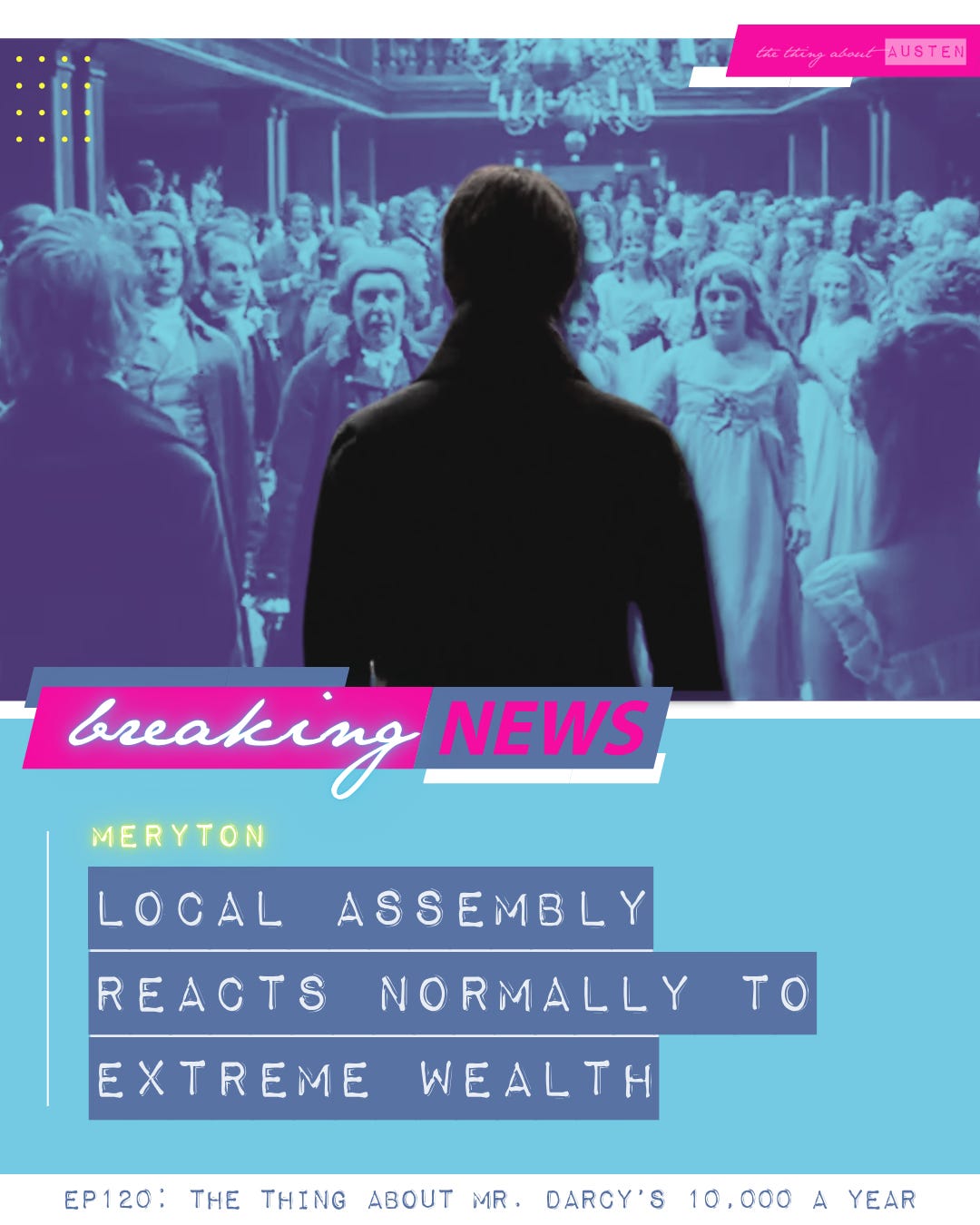
Mr. Darcy soon drew the attention of the room by his fine, tall person, handsome features, noble mien, and the report, which was in general circulation within five minutes after his entrance, of his having ten thousand a year.
Selected Sources:
Byrne, Sandie. “Material Goods in Austen’s Novels.” In The Routledge Companion to Jane Austen, 1st ed., by Edited By Cheryl A. Wilson and Maria H. Frawley. Routledge, 2021. https://doi.org/10.4324/9780429398155-16-19.
Copeland, Edward. “Money.” In Jane Austen in Context, edited by Janet Todd. Cambridge University Press, 2005. https://doi.org/10.1017/9781316036525.020.
Copeland, Edward. “Money.” In The Cambridge Companion to Jane Austen, 2nd ed., edited by Edward Copeland and Juliet McMaster. Cambridge University Press, 2010. https://doi.org/10.1017/CCO9780521763080.013.
Copeland, Edward. Women Writing About Money: Women’s Fiction in England, 1790 - 1820. Cambridge Univ. Press, 2004.
Francus, Marilyn. “Jane Austen, Pound for Pound.” Persuasions On-Line 33, no. 1 (2012). https://jasna.org/persuasions/on-line/vol33no1/francus.html?
Fullerton, Susannah. Celebrating Pride and Prejudice: 200 Years of Jane Austen’s Masterpiece. Voyageur Press, 2013.
Heldman, James. “How Wealthy Is Mr. Darcy – Really? Pounds and Dollars in the World of Pride and Prejudice.” Persuasions 12, no. 1 (1990).
Jones, Gareth, Jeremy Burchardt, and Richard Tranter. “The Survival of Three Large Agricultural Estates on the North Hampshire-South Berkshire Border During the Interwar Period.” Rural History 35, no. 2 (2024): 418–44. https://doi.org/10.1017/S0956793324000049.
Jones, Hazel. Jane Austen and Marriage. Continuum, 2009.
Lawson, Max. “Bridgerton, Jane Austen, and Today’s Wealth Dynasties.” Inequality.Org, January 25, 2021. https://inequality.org/article/bridgerton-austen-wealth-dynasties/.
Le Faye, Deirdre. Jane Austen: The World of Her Novels. Frances Lincoln, 2003.
McMaster, Juliet. “Class.” In The Cambridge Companion to Jane Austen, 2nd ed., edited by Edward Copeland and Juliet McMaster. Cambridge University Press, 2010. https://doi.org/10.1017/CCO9780521763080.013.
Mingay, G. E. English Landed Society in the Eighteenth Century. Routledge, 1963.
Mullan, John. What Matters in Jane Austen?: Twenty Crucial Puzzles Solved. Bloomsbury Press, 2014.
Pool, Daniel. What Jane Austen Ate and Charles Dickens Knew: From Fox Hunting to Whist; the Facts of Daily Life in Nineteenth-Century England. Touchstone, 2007.
Toran, Katherine. “The Economics of Jane Austen’s World.” Persuasions On-Line 36, no. 1 (2015). https://www.jasna.org/publications-2/persuasions-online/vol36no1/toran/.
A fascinating topic! And further evidence that Mrs. Bennet is actually trying to do right by her girls, even if she isn't super effective.
Whenever I teach historical novels, I assign one student to be the "money manager" and convert all the financials into modern terms. It's super fun!