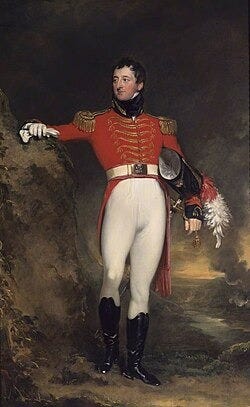
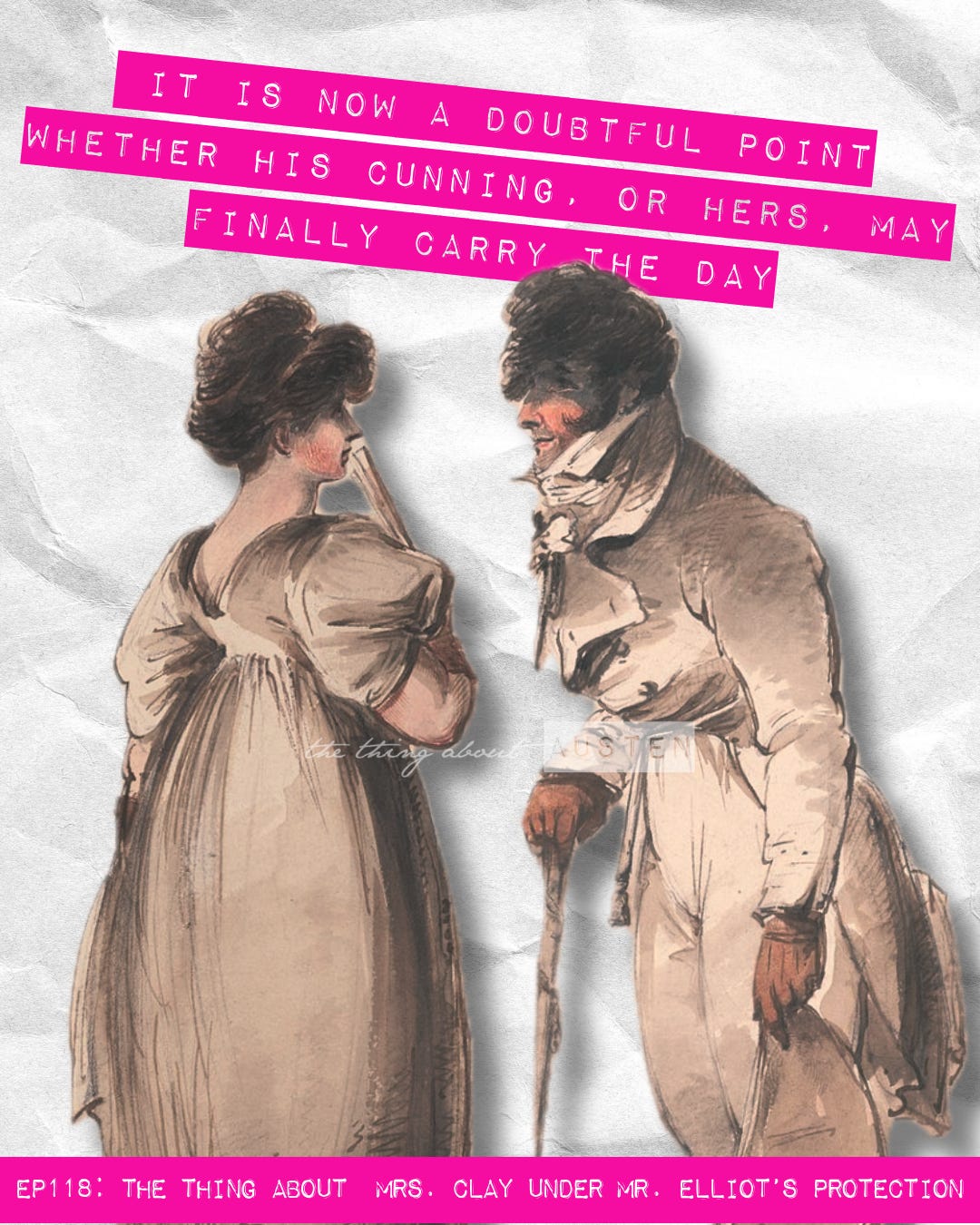
What exactly does Austen mean when she describes Mrs. Clay as being “under his protection”? And what’s in it for everyone involved? This episode we examine the role of mistresses in 18th-century society.
Selected Sources:
Adkins, Roy, and Lesley Adkins. Jane Austen’s England: Daily Life in the Georgian and Regency Periods. Penguin Books, 2014.
Burns, Margie. “Comic Resolution, Humorous Loose Ends in Austen’s Novels.” Persuasions 33, no. 1 (2011): 238–43.
Collinson, Alexandra. “New Feminist Approaches to 18th-Century Women’s Labour: Sex Work and Mother Work in The Memoirs of Mrs Margaret Leeson (1795–1797).” Feminist Theory, April 17, 2025, 14647001241308441. https://doi.org/10.1177/14647001241308441.
Collinson, Alexandra. “The Sex Workers’ Revolution: Prostitution, Feminism and Female Virtue in British and Irish Women’s Writing (1781-1801).” Doctoral Thesis, Newcastle University, 2024.
Corfield, Penelope J. The Georgians: The Deeds and Misdeeds of Eighteenth-Century Britain. Yale University Press, 2022.
Dabhoiwala, Faramerz. The Origins of Sex: A History of the First Sexual Revolution. London, England ; New York, N.Y. : Allen Lane, 2012. http://archive.org/details/originsofsexhist0000dabh.
Erickson, Amy Louise. “Mistresses and Marriage: Or, a Short History of the Mrs.” History Workshop Journal, no. 78 (2014): 39–57.
Gibson, Kate. “‘I Am Not on the Footing of Kept Women’: Extra-Marital Love in Eighteenth-Century England.” Cultural and Social History 17, no. 3 (2020): 355–73. https://doi.org/10.1080/14780038.2019.1642064.
Hickman, Katie. Courtesans: Money, Sex, and Fame in the Nineteenth Century. Morrow, 2003.
Holloway, Sally. “‘You Know I Am All on Fire’: Writing the Adulterous Affair in England, C. 1740-1830.” Historical Research 89, no. 244 (2016): 317–39. https://doi.org/10.1111/1468-2281.12130.
“Johnson’s Dictionary Online.” Accessed May 9, 2026. https://johnsonsdictionaryonline.com/index.php.
Kushner, Nina. “Sexual Capital and the Private Lives of Mistresses.” In Erotic Exchanges: The World of Elite Prostitution in Eighteenth-Century Paris. Cornell University Press, 2013.
Miller, Casey, and Kate Swift. Words and Women. Anchor Books, 1977. http://archive.org/details/wordswomen0000mill.
Morrison, Robert. The Regency Years: During Which Jane Austen Writes, Napoleon Fights, Byron Makes Love, and Britain Becomes Modern. W. W. Norton & Company, 2019.
Muir, Rory. Love and Marriage in the Age of Jane Austen. Yale University Press, 2024.
Murray, Venetia. An Elegant Madness: High Society in Regency England. Penguin, 2000.
Newark, Elizabeth. “Love Comes to Penelope Clay.” Persuasions 15, no. 1 (1993): 238–43.
Nigro, Jeffrey, and William Phillips. “Jane Austen, Madame de Staël, and the Seductiveness of Conversation.” Persuasions On-Line 33, no. 1 (2012). https://jasna.org/persuasions/on-line/vol33no1/nigro-phillips.html?
Peel, Katie R. Readers and Mistresses: Kept Women in Victorian Literature. Interventions : Rethinking the Nineteenth Century. Manchester University Press, 2024.
Rendell, Mike. Sex and Sexuality in Georgian Britain. Pen & Sword Books Limited, 2020.
Spampinato, Erin A. “Tom Became What He Ought to Be: Mansfield Park as Homosocial Bildungsroman.” Studies in the Novel 51, no. 4 (2019): 481–98. https://doi.org/10.1353/sdn.2019.0061.
Worsley, Lucy. The Courtiers: Splendor and Intrigue in the Georgian Court at Kensington Palace. Bloomsbury Publishing USA, 2010.
“Eliza has seen Lord Craven at Barton, & probably by this time at Kintbury, where he was expected for one day this week. —She found his manners very pleasing indeed. —The little flaw of having a Mistress now living with him at Ashdown Park, seems to be the only unpleasing circumstance about him.”
—Letter from Jane Austen to Cassandra Austen, January 8, 1801
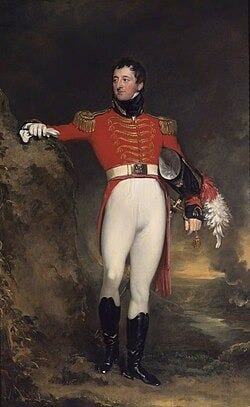
William Craven, 1st Earl of Craven, the Lord Craven referenced by Austen Other Relevant Episodes
Episode 09: The Thing About the Rushworths’ Divorce with guest Dr. Ellen Campbell
Episode 34: The Thing About Edward’s Hair Ring with guest Dr. Sally Holloway